AI and Taxes: A Powerful Assistant, but a Dangerous Advisor
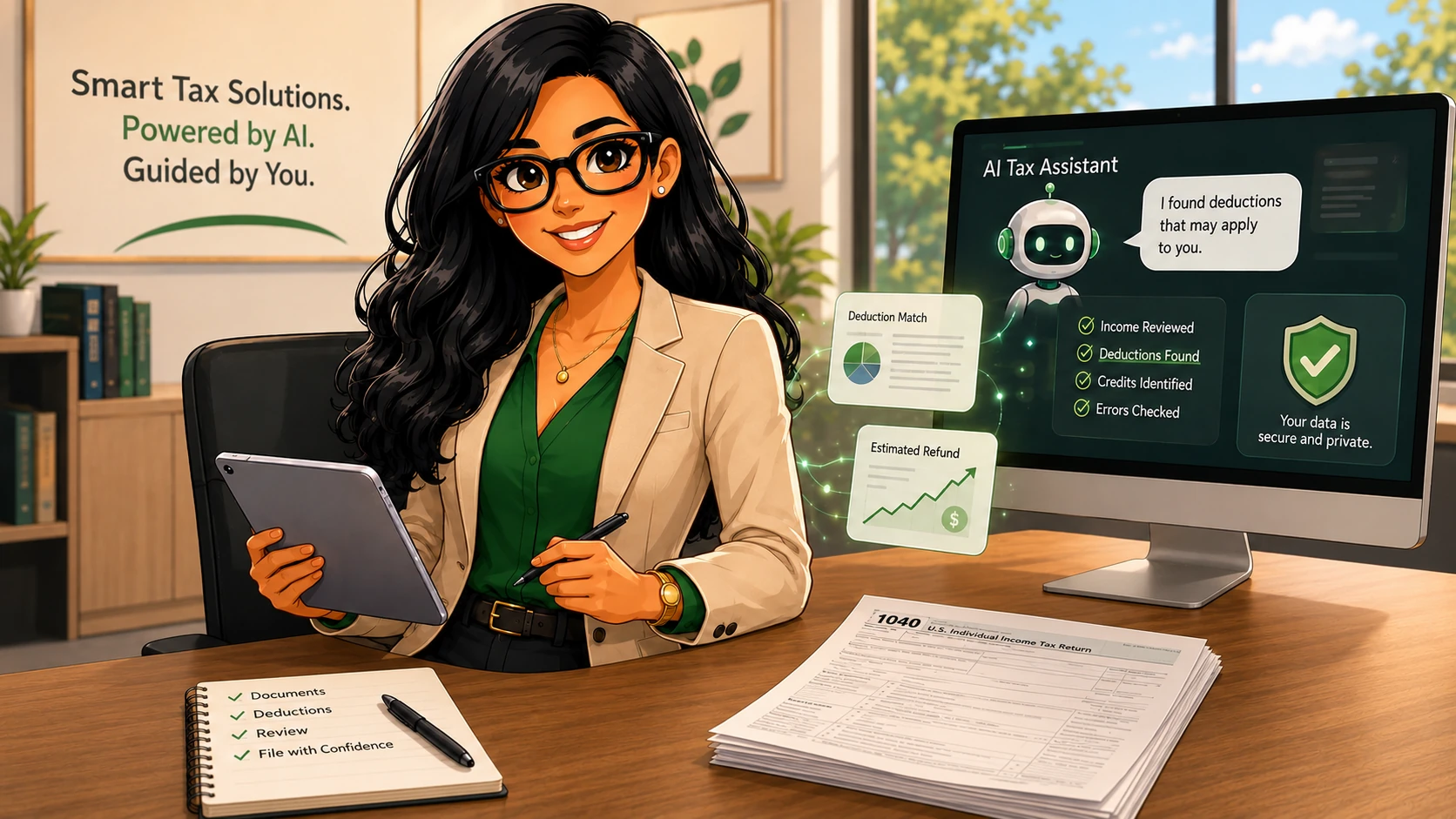
Artificial intelligence can make tax work faster, but it cannot make tax professionals less responsible.
The question is no longer whether artificial intelligence belongs in the tax industry. It already does.
Tax firms use AI to organize documents, summarize tax notices, research legal issues, draft client communications, review returns, and automate routine administrative work. Some firms have also placed AI chatbots on their websites to answer questions from taxpayers around the clock.
Run your tax office from one bilingual system.
See how Conecta handles clients, messages, documents, reminders, and workflows.
The attraction is obvious: AI is fast, inexpensive, and available at any hour. But tax law is not an ordinary customer-service problem. A confident but incorrect answer can affect a person’s filing status, deductions, credits, tax liability, penalties, or response to an IRS notice.
That is why the most important question is not:
“Can an AI system answer tax questions?”
It is:
“Should anyone rely on that answer without a qualified tax professional checking it?”
The answer, in most situations involving an individual taxpayer’s facts, should be no.
The IRS has now addressed AI directly
In June 2026, the IRS Office of Professional Responsibility issued introductory guidance explaining how existing professional-responsibility rules apply when tax practitioners use generative AI.
The guidance does not prohibit AI. Instead, it emphasizes that the duties tax professionals already have—accuracy, diligence, competence, confidentiality, proper supervision, reasonable fees, and reliable written advice—remain in place when AI is used.
Circular 230 already requires practitioners to exercise due diligence when preparing tax documents, communicating with the IRS, and making representations to clients. It also requires practitioners to possess the knowledge, skill, thoroughness, and preparation needed for the work they accept.
AI does not change those obligations. It only changes the tool being used.
The biggest misconception: security does not equal accuracy
Much of the discussion about AI in tax practice focuses on whether a platform is “secure” or “enterprise approved.”
That matters. Tax information is highly sensitive, and the IRS warns practitioners not to upload taxpayer information into unsecured or public AI systems. The IRS also says firms should establish access controls, vet outside AI vendors, document procedures, train employees, and use strong confidentiality safeguards.
But security answers only one question:
Will the system protect the information entered into it?
Security does not answer another equally important question:
Will the system produce a correct tax answer?
A platform can have encryption, multifactor authentication, audit logs, contractual confidentiality protections, and an impressive security certification—and still hallucinate.
A secure hallucination is still a hallucination.
Why AI hallucinations are especially dangerous in tax
Generative AI does not determine truth in the same way a qualified professional researches and evaluates a legal issue. It predicts a useful-looking response based on patterns in data.
That means an AI system can:
- Invent a court case or IRS ruling
- Cite a real authority that does not support its conclusion
- Apply an outdated tax provision
- Miss an exception buried in a regulation
- Confuse federal and state tax rules
- Perform a calculation using an incorrect assumption
- Overlook a fact that changes the result
- Give different answers when the same question is phrased differently
- Sound completely confident while being wrong
The IRS guidance expressly identifies fabricated outputs, bias, lack of transparency, privacy concerns, and confidentiality risks as limitations of generative AI. It instructs practitioners to verify AI-produced facts, calculations, citations, legal authorities, financial forecasts, and formulas.
The greatest danger is not an obviously ridiculous answer. Those are easy to reject.
The dangerous answer is the one that is 90 percent correct, professionally written, and wrong in one decisive way.
Tax questions rarely have enough facts in the first message
Consider a taxpayer who asks a chatbot:
“Can I claim my nephew as a dependent?”
A chatbot may be tempted to answer yes or no. But a reliable conclusion could depend on:
- The nephew’s age
- His relationship to the taxpayer
- Where he lived during the year
- Whether an absence was temporary
- How much support he provided for himself
- His gross income
- Whether he filed a joint return
- Whether another person is eligible to claim him
- Whether special custody or residency rules apply
- The tax year involved
The correct professional response is often not an immediate answer. It is a series of follow-up questions.
This is one of the central weaknesses of autonomous tax chatbots: the interface encourages speed and certainty, while responsible tax advice often requires investigation, documentation, and professional judgment.
Circular 230 allows practitioners to rely in good faith on client information in many circumstances, but they may not ignore information that appears incorrect, inconsistent, or incomplete. They must make reasonable inquiries when the facts raise questions.
A polished chatbot answer cannot substitute for missing facts.
When a tax chatbot becomes more than customer service
Not every chatbot function presents the same level of risk.
A chatbot that answers questions such as these is generally performing a limited administrative role:
- “What are your office hours?”
- “How do I schedule an appointment?”
- “Which documents should I bring?”
- “Where can I upload my W-2?”
- “Has my return been completed?”
- “What services does your firm offer?”
A chatbot may also provide carefully controlled educational information, such as a general explanation of what a W-2 is or a list of commonly requested documents.
The risk rises sharply when the chatbot begins applying tax law to a user’s personal facts.
Examples include:
- “You qualify for Head of Household.”
- “You can claim your mother as a dependent.”
- “This business expense is deductible.”
- “You do not need to report that income.”
- “Treat this worker as an independent contractor.”
- “The IRS notice is incorrect.”
- “You should amend your return.”
- “Claim this credit on your tax return.”
Those are not ordinary customer-service responses. They are individualized tax conclusions that the taxpayer may act upon.
Circular 230 expressly includes electronic communications within its written-advice rules. Written tax advice must be based on reasonable factual and legal assumptions, consider relevant circumstances, identify the pertinent facts, and relate the applicable law to those facts.
A disclaimer at the bottom of the screen does not change what the chatbot actually did.
“This is not tax advice” is not a magic shield
Many tax chatbots display a disclaimer stating that the information is educational and should not be treated as tax advice.
A clear disclaimer can help establish appropriate expectations. But it cannot excuse a system that is designed to provide personalized tax recommendations.
Imagine a chatbot saying:
“Based on the information you entered, you qualify for the credit and should claim it. This response is not tax advice.”
The second sentence does not erase the first.
The meaningful questions are:
- Did the bot request the taxpayer’s personal information?
- Did it apply tax law to those facts?
- Did it make a recommendation?
- Was the answer presented under the tax firm’s name?
- Was the taxpayer encouraged to rely on it?
- Did a qualified professional review the answer before it was delivered?
The substance of the interaction matters more than the label placed beneath it.
Who is responsible when the chatbot is wrong?
An AI system cannot accept professional responsibility, appear at a disciplinary proceeding, or lose its right to practice before the IRS.
The practitioner and the firm remain exposed.
Circular 230 requires people responsible for overseeing a tax practice to take reasonable steps to establish adequate compliance procedures for the firm. Supervisors can be disciplined when they fail to create proper procedures, fail to ensure those procedures are followed, or know—or should know—about a pattern of violations and fail to correct it.
The IRS AI guidance applies that principle directly to AI. It says firms should:
- Train employees on AI risks and requirements
- Establish secure data-handling protocols
- Monitor AI accuracy
- Vet third-party AI providers
- Document procedures and verification processes
- Prepare procedures for errors and breaches
- Maintain human supervision
A tax-firm owner cannot simply install a chatbot, allow it to answer tax questions, and blame the vendor when it gives bad advice.
When a chatbot carries the firm’s logo and communicates with the firm’s clients, the firm should assume that users will perceive its answers as coming from the firm.
Confidentiality creates a separate risk
Even when a chatbot does not provide a final tax conclusion, the information it collects can create serious concerns.
Tax-return information is defined broadly. It can include not only Social Security numbers, bank information, and completed returns, but also a taxpayer’s name, address, identifying number, financial facts, and other information furnished in connection with preparing a return.
A chatbot may therefore collect protected information when it asks questions such as:
- What is your filing status?
- How much did you earn?
- How many dependents do you have?
- Did you receive unemployment compensation?
- Upload your W-2 or IRS notice.
- Enter your Social Security number.
- Describe why you believe you qualify for the credit.
Before allowing a chatbot to handle that information, a firm needs to understand:
- Whether prompts and uploads are used to train models
- How long the information is retained
- Where the information is stored
- Who can access it
- Whether vendor personnel can review it
- Which subcontractors receive it
- Whether it is encrypted
- How access is removed
- How data can be deleted
- What happens after a security incident
- What contractual protections the vendor provides
Calling a product “enterprise” does not by itself resolve those questions.
The safer role for AI in tax practice
AI can still provide substantial value. The better model is to use it as an assistant rather than as the final decision-maker.
AI is well suited to tasks such as:
- Organizing client documents
- Extracting information from tax forms
- Summarizing an IRS notice
- Drafting an internal research memo
- Identifying questions that should be asked
- Locating potentially relevant authorities
- Comparing documents for inconsistencies
- Preparing a first draft of a client response
- Translating an approved explanation into plain language
- Handling scheduling, intake, and administrative requests
But the workflow should not end with the AI output.
For significant tax matters, a qualified person should:
- Confirm the taxpayer’s facts.
- Identify missing or inconsistent information.
- Review the original source documents.
- Read and verify the authorities cited.
- Check calculations and formulas.
- Determine whether the law actually applies.
- Edit the response.
- Approve the final conclusion before it reaches the taxpayer or the IRS.
The IRS describes AI-generated written material as a starting point that requires thorough human review, rather than a finished professional product.
A better design for tax chatbots
A responsible tax chatbot should have clear boundaries.
It may answer automatically
The chatbot may handle:
- Office information
- Appointment scheduling
- Secure-upload instructions
- Document checklists
- General filing-process explanations
- Preapproved educational content
It should gather information and escalate
When a question requires individual analysis, the chatbot should collect the relevant background and say:
“The answer depends on your specific tax circumstances. I have gathered your information and sent the question to your tax professional for review.”
It may prepare an internal draft
Behind the scenes, the system can give the practitioner:
- A summary of the taxpayer’s question
- The facts collected
- Missing questions
- Potential tax issues
- Possible authorities
- A proposed response
- A verification checklist
The professional can then approve, edit, or reject the draft.
That design preserves much of AI’s efficiency without pretending that the technology can reliably exercise professional judgment on its own.
AI may also affect how tax firms bill
The IRS guidance raises another issue that firms should not ignore: billing.
AI may dramatically reduce the time required to research an issue or prepare a first draft. The IRS warns that billing for manual work or time that was not actually spent—or double billing for AI-assisted tasks—may become an unconscionable-fee issue depending on the circumstances. The guidance encourages transparency and says meaningful AI-related cost reductions should be fairly reflected in client accounts.
This does not mean firms must abandon flat fees or value-based pricing. It means billing descriptions and charges should be honest.
A firm should not claim that a professional spent five hours manually researching and drafting a memorandum when an AI system generated the initial document in minutes and the professional spent one hour reviewing it.
What taxpayers should ask before trusting an AI tax tool
Taxpayers should not assume that a tax chatbot is reliable because it looks professional or is offered by a tax company.
Useful questions include:
- Is this providing general information or advice about my individual situation?
- Will a tax professional review the answer?
- What qualifications does that reviewer have?
- Does the answer cite an IRS source or other authority?
- Has the source actually been checked?
- What happens if the answer is wrong?
- Is my information stored?
- Is my information used to train an AI model?
- Can I have my data deleted?
- Is the chatbot operated by the tax firm or an outside vendor?
Most importantly, taxpayers should be cautious when an AI gives a quick, definitive answer to a question that would normally require a professional to examine documents and ask follow-up questions.
The right conclusion is not “never use AI”
AI is not inherently incompatible with tax practice.
Used responsibly, it can reduce repetitive work, improve document organization, help professionals identify issues, and give tax practitioners more time for analysis and client service.
But AI should not be trusted merely because it is fast, secure, specialized, or confident.
The standard should be simple:
AI may assist with the work. A qualified human must remain responsible for the conclusion.
Security protects taxpayer information. Human review protects taxpayers from incorrect advice. A responsible tax practice needs both.
The firms most likely to benefit from AI will not be those that remove professionals from the process. They will be those that use technology to make their professionals better prepared, better informed, and more efficient—while keeping judgment and accountability exactly where they belong.
This article reflects the June 2014 edition of Circular 230 and the IRS Office of Professional Responsibility’s introductory AI guidance issued June 24, 2026. It is intended for general educational purposes and is not legal or tax advice.
Need a bilingual CRM built for tax offices?
Conecta combines CRM, client portal, automations, and bilingual workflows in one system made specifically for tax professionals.